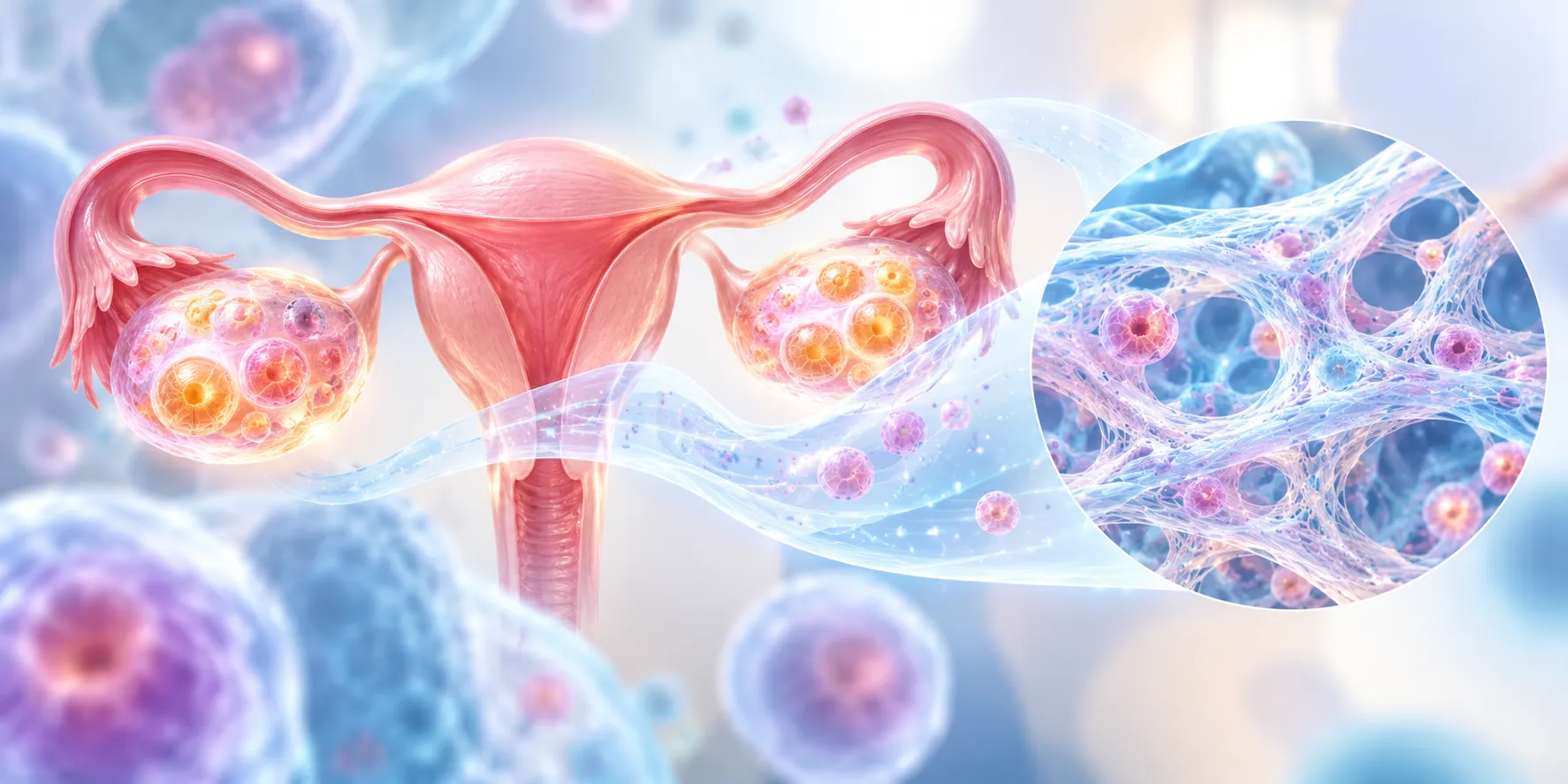
Supporting the ovarian microenvironment and tissue regeneration to promote healthier cellular function and reproductive potential.
The ovary’s scaffold
a network of proteins and sugars such as collagen, fibronectin, laminin and hyaluronan
Stiffens with age
research shows more scar-like tissue (fibrosis) in older ovaries, but its exact role in fertility is still being worked out
No proven ECM treatment
no ECM-based therapy has been shown to restore egg supply or quality in women
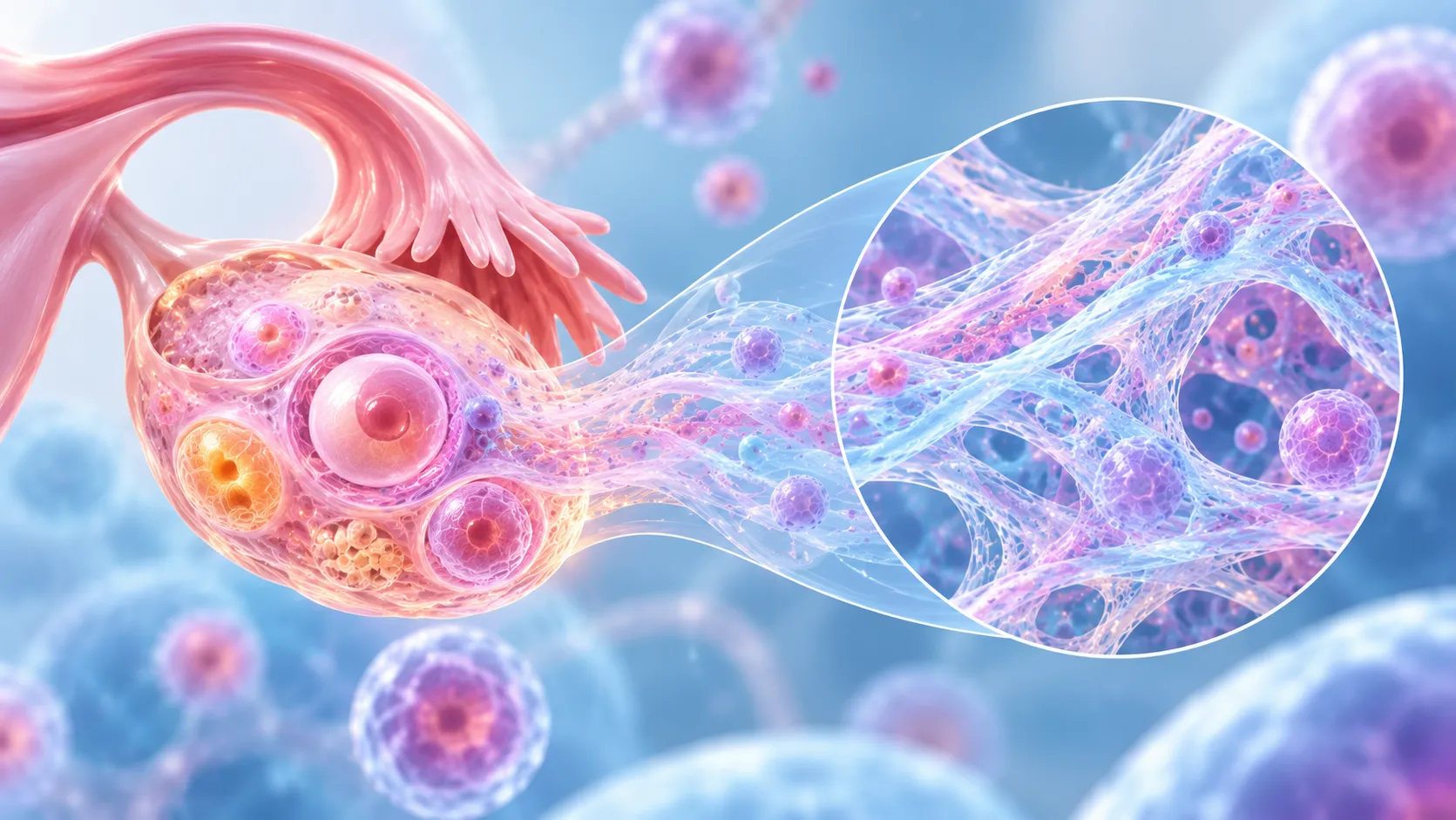
Every tissue in the body is made of cells and the material between them. That material is the extracellular matrix (ECM). In the ovary it forms the framework that supports follicles (the small fluid-filled sacs each holding an egg), anchors the cells around them, stores growth signals, and controls how soft or stiff the tissue feels.
Scientists have found that follicles grow best in the right physical setting. A softer, well-organised matrix appears to help follicles stay resting and then grow when the time is right, while a stiffer matrix may change how they behave. This is why the ECM has become a research topic for ovarian ageing, premature ovarian insufficiency (POI) and fertility preservation.
Understanding the ECM is real science. But understanding a scaffold is not the same as being able to repair it, and no one has yet shown that changing the ECM in a woman’s ovary improves her chance of a baby.
The table shows the idea being tested and, importantly, how far the evidence has come:
| Area | The Idea Being Tested | Stage of Evidence |
|---|---|---|
| Ovarian ageing and fibrosis | Whether stiffening of the matrix affects follicle growth, and whether anti-fibrotic drugs could soften it | Mainly laboratory and animal studies; no human treatment |
| Bioengineered “artificial ovary” (scaffolds) | Growing follicles inside a supportive scaffold, for women whose ovaries cannot be safely restored after cancer treatment | Animal studies, including live births in mice; human use still experimental |
| Decellularised ovarian tissue | Removing the cells from donor ovarian tissue and using the leftover matrix as a natural scaffold | Laboratory and animal research only |
| Follicle culture in the laboratory | Using matrix-like gels to grow immature follicles into mature eggs outside the body | Laboratory research; not available as a treatment |
| Ovarian “rejuvenation” injections (PRP,or other products) | Injecting a product into the ovary to improve its environment and wake up follicles | Small, mostly uncontrolled studies; not recommended outside research |
The ovary is delicate, and its egg supply cannot be replaced once damaged. Important open questions include:
Professional bodies such as the European Society of Human Reproduction and Embryology (ESHRE) advise that add-on procedures should only be offered when there is good evidence that they help, and that unproven ovarian injection techniques should be limited to properly approved research.
Ovarian tissue freezing before cancer treatment, and re-transplanting the woman’s own tissue afterwards, is a recognised fertility preservation option for selected patients and is different from the ECM research described here.
Matrix scaffolds, tissue-derived products and cell-based injections are still investigational. In India, assisted reproduction is governed by the Assisted Reproductive Technology (Regulation) Act, 2021, and cell- or tissue-derived biological products fall under the New Drugs and Clinical Trials Rules, 2019, which require CDSCO approval before routine clinical use. We are not aware of any approved ovarian ECM therapy for routine fertility treatment in India.
Rules differ by country and continue to evolve, so it is always fair to ask any clinic to show you the approval that covers what it is offering.
These terms are often mixed up. They are different things with very different levels of evidence:
| Feature | Ovarian Tissue Freezing | Ovarian PRP Injection | ECM Scaffold / Artificial Ovary |
|---|---|---|---|
| What it is | Removing and freezing a piece of ovary to be replaced later | Platelet concentrate from your blood injected into the ovary | A supporting framework that holds follicles or ovarian cells |
| Main purpose | Preserving fertility before treatments that damage the ovary | Trying to improve a poor ovarian response | Restoring ovarian function where it cannot be restored otherwise |
| Usual source | Your own ovarian tissue | Your own blood | Donor tissue, natural proteins or lab-made materials |
| Regulatory position in India | Offered in selected specialised centres for medical indications | Not an established fertility treatment; best within research | Investigational; approval needed before clinical use |
| Strength of evidence | Good for selected patients, with many babies born worldwide | Weak; small, mostly uncontrolled studies | Early; mostly laboratory and animal data |

It is the framework of proteins and sugars that fills the space between the cells of the ovary. It supports follicles and helps guide how they grow.
No. ECM-based approaches are still being studied. We are not aware of any approved ECM therapy for routine fertility treatment in India, and clinics should be able to show you the approval or trial that covers anything they offer.
There is no proof that it can. The research is mostly at the laboratory and animal stage. Established fertility care, such as evaluation, medication, IUI and IVF, remains the recommended path, and some women with POI may be advised on egg donation.
No. Fibrosis is a research finding in ageing ovaries, not a test or a diagnosis you can be given on a scan. Fertility depends mainly on age and on the number and quality of your eggs, so speak to your doctor about a proper assessment.
Not as a treatment. Bioengineered ovary research has produced encouraging results in animals, but human use is experimental. Ovarian tissue freezing is the established option for women facing cancer treatment.
No, though clinics sometimes sell them under a similar “rejuvenation” label. They are different products with different sources and risks, and none has been proven to restore ovarian function.
Safety depends on the procedure and on what is used. Any injection or surgery on the ovary carries risks, and the long-term effect of unapproved products is unknown. This is why only approved, carefully supervised research should be considered.
Because patients are increasingly approached with “ovarian rejuvenation” offers, and trustworthy information is hard to find. We believe informed patients make safer decisions, whether or not they choose to be treated with us.
Get a proper assessment of your ovarian reserve and discuss the proven options for your age and condition. If you are interested in newer approaches, ask your doctor about registered clinical trials, where treatment is supervised and monitored.
Speak with the StemRx team for a proper evaluation and a straightforward discussion of what is proven, what is promising and what to avoid.