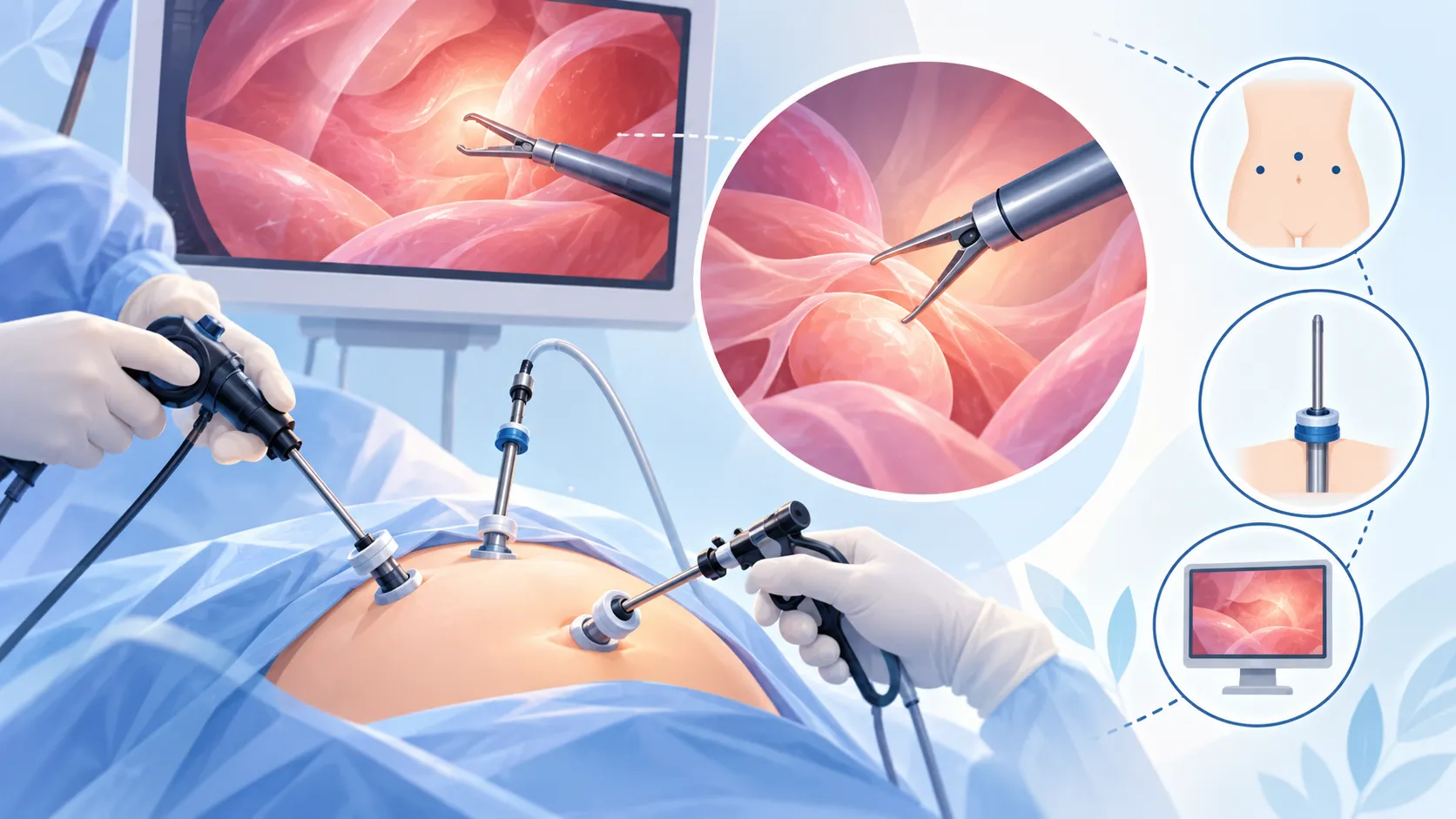
A minimally invasive surgical approach using small incisions for precise diagnosis and treatment with reduced recovery time.
Keyhole surgery
a thin camera and instruments go in through small cuts, usually under general anaesthesia
Diagnoses and treats
many problems found during the look can be treated in the same sitting
Not for everyone
scans and simpler tests come first; not every fertility work-up needs an operation
In a laparoscopy, the surgeon makes a small cut near the navel and gently fills the abdomen with carbon dioxide gas so the organs can be seen clearly. A thin telescope with a camera is passed through the cut. Usually one to three other tiny cuts are made for instruments, so the surgeon can look at, and if needed treat, the womb, fallopian tubes, ovaries and the lining of the pelvis.
There are two broad types:
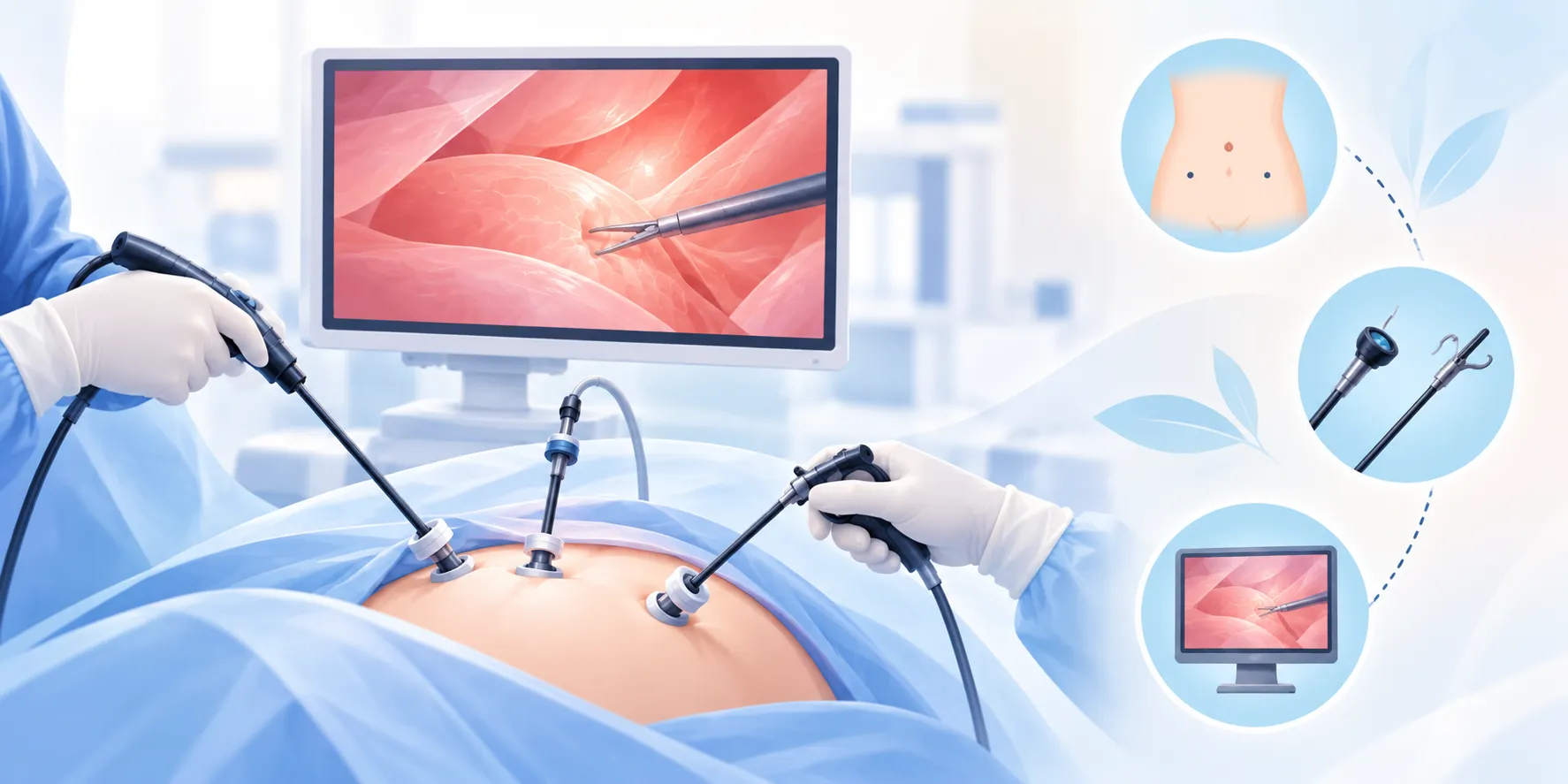
Because the cuts are small, laparoscopy usually means less pain, a shorter hospital stay and quicker recovery than open abdominal surgery.
The table shows common reasons for laparoscopy in women’s health and fertility, and what else may be considered:
| Situation | What Laparoscopy Can Do | Notes and Alternatives |
|---|---|---|
| Suspected endometriosis or pelvic adhesions | Confirms the diagnosis and removes or treats the disease in the same sitting | Scans and MRI can find some disease; medicines are an option for pain |
| Blocked or swollen tube (hydrosalpinx) before IVF | Removes or blocks the affected tube so it does not harm IVF results | Tubal patency is usually first checked with an HSG or scan |
| Ovarian cyst or endometrioma | Removes the cyst when it is painful, large or suspicious | Surgery can reduce egg reserve; observation may suit small cysts |
| Fibroids | Removal of selected fibroids (laparoscopic myomectomy) | Many fibroids need no surgery; location decides the route |
| PCOS not responding to tablets | Ovarian drilling can trigger ovulation in selected women | Usually considered after medicines such as letrozole, or alongside them |
| Ectopic pregnancy | Removes the pregnancy from the tube, sometimes with the tube | Medicine (methotrexate) suits some early cases; an emergency if the tube has ruptured |
| Unexplained infertility | Can find hidden disease, but not everyone benefits | Not a routine test; usually reserved for pelvic pain or other risk factors |
Fertility guidance, such as that from NICE in the UK, does not recommend laparoscopy as a routine first test. Simpler investigations usually come first: hormone tests, semen analysis, an ultrasound scan, and a test of tubal patency such as an HSG or a saline scan. Laparoscopy is usually kept for women with pelvic pain, suspected endometriosis, previous pelvic infection or ectopic pregnancy, or scan findings that need treatment.
Seek medical help promptly if you have fever, severe or worsening abdominal pain, repeated vomiting, heavy bleeding, redness or discharge from a wound, or difficulty passing urine.
Laparoscopy is generally safe in experienced hands, but it is still surgery under general anaesthesia:
Right indication. Guidelines from bodies such as NICE and ESHRE describe when laparoscopy is worthwhile in fertility care and when simpler tests should come first.
Surgeon experience matters. Ask about your surgeon’s experience with the specific procedure, especially for endometriosis or ovarian surgery, where careful technique protects egg reserve.
Safe systems. Reputable hospitals follow safety routines such as the WHO Surgical Safety Checklist, have a trained anaesthetist, and are equipped to manage bleeding or convert to open surgery if needed.
Informed consent. You should be told the reasons, the risks, the alternatives and what may be done if something unexpected is found, and asked to consent in writing before surgery.
These are often confused. They look at different places and suit different problems:
| Feature | Laparoscopy | Hysteroscopy | HSG / Saline Scan | Open Surgery |
|---|---|---|---|---|
| What it looks at | The outside of the womb, tubes, ovaries and pelvic lining | The inside of the womb cavity | The shape of the cavity and whether the tubes are open | Whole abdomen and pelvis through one larger cut |
| Cuts on the abdomen | Small cuts | None | None | One larger cut |
| Anaesthesia | General | None, sedation or general | None needed | General or spinal |
| Can treat at the same time? | Yes | Yes, for problems inside the cavity | No; it is a test only | Yes |
| Main considerations | Surgical risks; needs a trained surgeon | Cannot see the tubes or ovaries from outside | Cannot see endometriosis or adhesions clearly | More pain, longer recovery and more scarring |
In fertility work-ups, laparoscopy and hysteroscopy are sometimes done together under one anaesthetic, so the whole pelvis and womb cavity are assessed in a single sitting.
You will be asleep during the procedure. Afterwards there is usually mild to moderate discomfort at the cuts, cramping and shoulder-tip pain from the gas, which settle within a few days and respond to simple pain relief.
A diagnostic procedure often takes 20 to 40 minutes. Operative laparoscopy can take one to several hours, depending on what is being treated.
It can, when it finds and treats a specific problem such as mild endometriosis or a damaged tube before IVF. If nothing is found, or the problem is not treatable, it may not change your chance, which is why it should be used only for good reasons.
No. Many women go to IVF without it. It is considered when there is pelvic pain, suspected endometriosis, a swollen tube or another finding that scans suggest may affect treatment.
Laparoscopy looks at the outside of the womb, tubes, ovaries and pelvis through small cuts in the abdomen. Hysteroscopy looks inside the womb cavity through the vagina and cervix, with no cuts.
The cuts are small, often around a centimetre or less, with one hidden in the navel. They usually fade well over time.
After a purely diagnostic laparoscopy, many women can try in the next cycle. After operative surgery, timing depends on what was done, so follow your surgeon’s advice.
Serious complications are uncommon, and laparoscopy is widely used. It is still surgery under general anaesthesia, so it should be done for good reasons, by a trained surgeon, in a well-equipped hospital.
Because many couples are advised to have surgery without a clear explanation of the reasons, options or risks. We believe informed patients make safer decisions, whether or not they choose to be treated with us.
Speak with the StemRx team for a proper evaluation and a straightforward discussion of whether you need laparoscopy, what it can tell us, and how it fits with your plans for pregnancy.