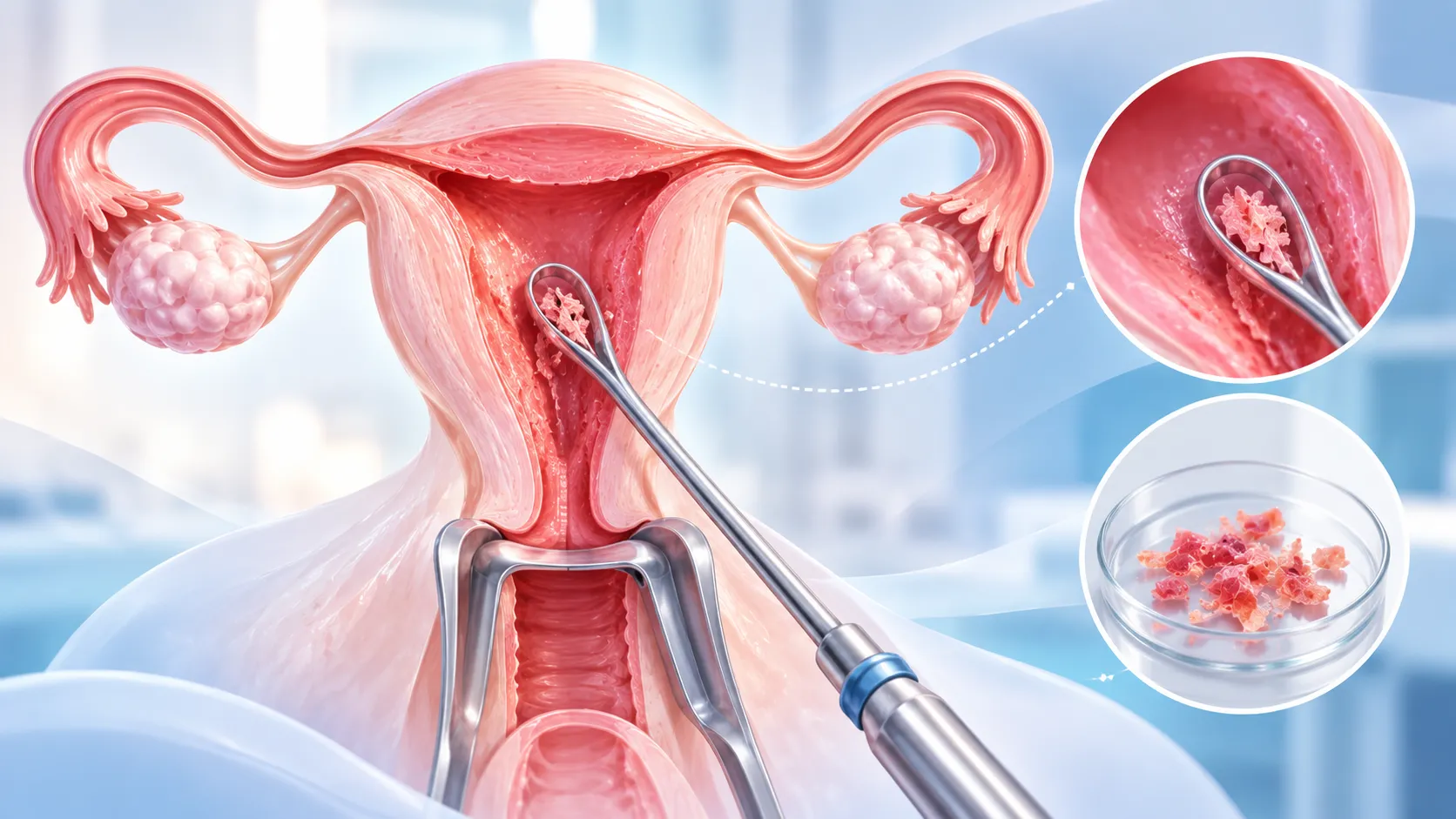
A safe procedure to remove tissue from the uterus for diagnosis or treatment while supporting overall uterine health.
A short day-care procedure
usually done under anaesthesia and often over within 10 to 30 minutes
Not a fertility treatment
“cleaning the womb” does not improve the chance of pregnancy
Gentler options exist
suction removal, medicines and hysteroscopy are often preferred to old-style scraping
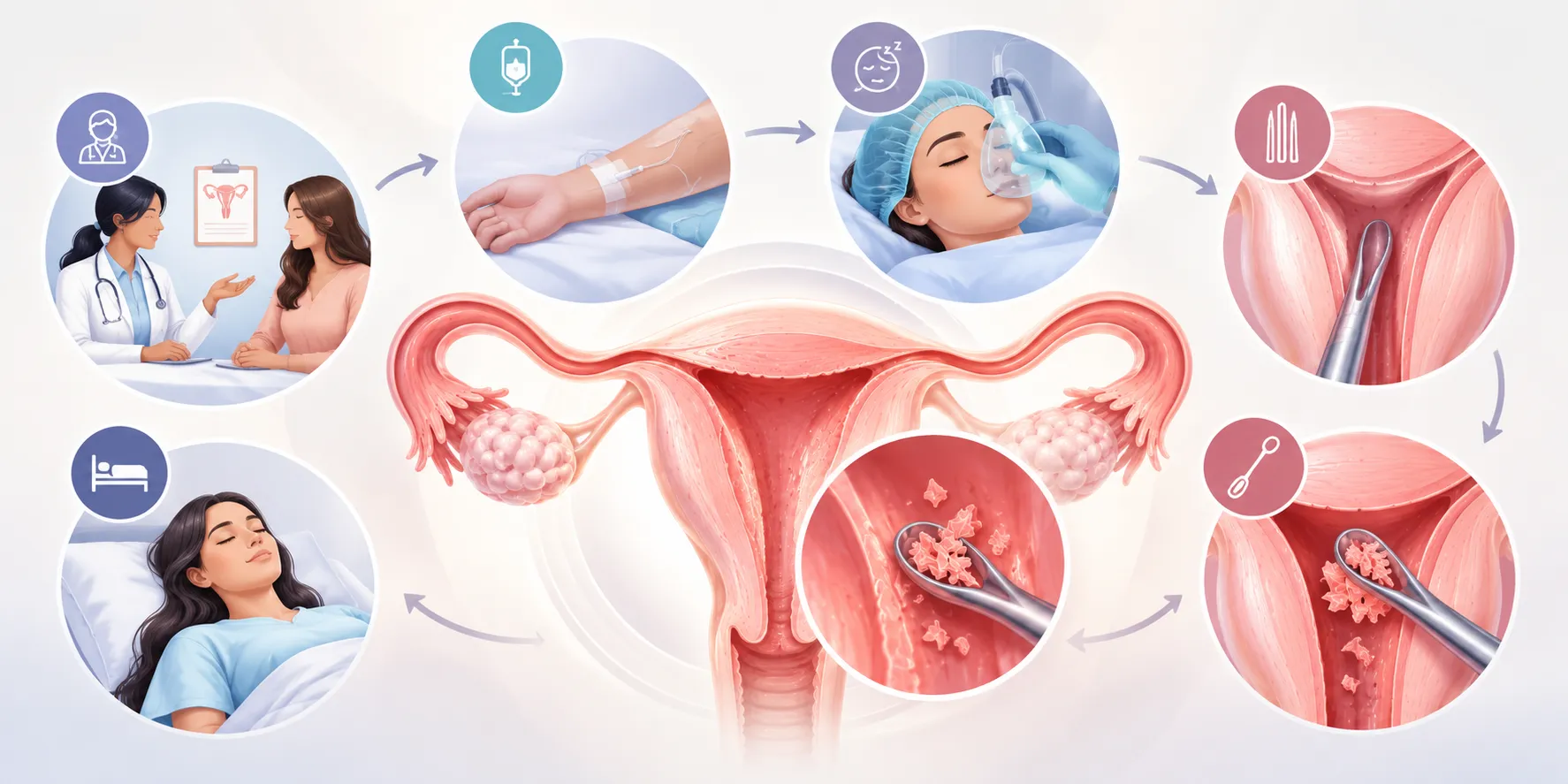
In a dilation and curettage, the doctor gently opens (dilates) the cervix and then removes tissue from the lining of the womb (curettage) using a thin instrument or suction. The tissue is usually sent to a laboratory for examination.
The term is used loosely. Some “D&Cs” are done by scraping with a metal instrument (sharp curettage), and others by suction (vacuum aspiration). Increasingly, doctors prefer suction or a camera-guided procedure, because these are considered safer and more precise.
A D&C is a useful and often necessary procedure. The important questions are whether it is the right one for your situation, and how it is done.
The table shows common reasons for a D&C and the alternatives that may be worth discussing:
| Situation | Role of D&C | Other Options to Ask About |
|---|---|---|
| Missed or incomplete miscarriage | Removes remaining tissue quickly and predictably | Waiting for natural passage, tablets (misoprostol), or suction removal |
| Heavy or irregular bleeding | Gives a tissue sample from the lining | Ultrasound, office biopsy, or hysteroscopy with a targeted biopsy |
| Retained tissue after delivery | Removes retained tissue to stop bleeding or infection | Medicines in selected cases; suction removal |
| Polyps or suspected growth in the womb | “Blind” scraping can miss the growth | Hysteroscopy, where the doctor sees and removes it under direct vision |
| Infertility or repeated IVF failure | Not a treatment; no proven fertility benefit from a routine D&C | Ultrasound and hysteroscopy to look for a specific problem |
Seek medical help promptly if you have heavy bleeding (soaking through a pad every hour for two hours), fever, severe or worsening pain, or foul-smelling discharge.
A D&C is generally safe when done by an experienced doctor, but it is still a procedure inside the womb. Important points to know:
If you have had a D&C and later struggle to conceive, have very light periods, or have had repeated miscarriages, tell your fertility doctor. A hysteroscopy can check the womb cavity directly for scarring.
Suction is preferred over sharp scraping. The World Health Organization recommends vacuum aspiration or medicines rather than sharp curettage for removing pregnancy tissue, because they are generally safer and less painful.
See the womb before treating it. For suspected polyps, fibroids or scarring, a camera-guided procedure (hysteroscopy) is usually more accurate than blind scraping.
Miscarriage care has choices. Guidelines from bodies such as ACOG and NICE describe waiting, tablets and surgery as valid options for early pregnancy loss, to be chosen with the patient.
Termination of pregnancy in India is governed by the Medical Termination of Pregnancy Act, which requires the procedure to be done by a registered doctor at an approved facility.
These are often all called a “D&C”, but they are different procedures:
| Feature | Sharp Curettage (D&C) | Suction (Vacuum) Removal | Medicines (Misoprostol) | Hysteroscopic Removal |
|---|---|---|---|---|
| How it works | Metal instrument scrapes the lining | Gentle suction empties the womb | Tablets cause the womb to expel tissue | Tissue is removed under direct camera view |
| Anaesthesia | Usually general or spinal | Local, sedation or general | None needed | Local, sedation or general |
| Best for | Now used less; some diagnostic or emergency situations | Miscarriage and retained tissue | Early miscarriage when the woman prefers to avoid surgery | Polyps, retained tissue and suspected scarring |
| Main considerations | Higher chance of lining damage and adhesions when done blind | Considered safer and less painful than sharp scraping | Bleeding and cramps at home; sometimes a repeat procedure is needed | Needs specialised equipment and training |

You will be under anaesthesia or sedation, so you should not feel the procedure. Afterwards there is usually cramping like period pain, which is managed with simple pain relief.
Most women who have a single D&C go on to have healthy pregnancies. The risk of scarring and other complications is higher after repeated procedures, so tell your doctor about any previous D&C.
No. Depending on your situation, you can wait for the miscarriage to pass naturally, take tablets, or have suction removal or a D&C. Your doctor will advise, but the choice should be discussed with you.
There is no reliable evidence that a routine D&C improves fertility or IVF results. If there is a specific problem, such as a polyp or scarring, a camera-guided procedure targets it directly.
No. An endometrial scratch is a minor procedure that lightly irritates the lining, sometimes offered before IVF. A large trial found it did not improve live birth rates, and the UK’s fertility regulator gives it its lowest rating for effectiveness.
Many doctors advise waiting until you have had at least one normal period, but this depends on why the D&C was done and how you are recovering. Follow your own doctor’s advice.
It is scarring inside the womb, most often after procedures such as D&C, that can cause light periods, difficulty conceiving or miscarriage. It can be diagnosed with hysteroscopy and often treated by removing the scar tissue.
Call promptly if you have heavy bleeding, fever, severe or worsening pain, or foul-smelling discharge. Also let your doctor know if your periods do not return within about six to eight weeks.
Because many women are advised to have a D&C without a clear explanation of the reasons, options or risks. We believe informed patients make safer decisions, whether or not they choose to be treated with us.
Speak with the StemRx team for a proper evaluation and a straightforward discussion of whether you need a D&C, which technique suits you, and how it fits with your plans for pregnancy.